


Europe Solar Panel Market Growth Trends and Forecast Outlook 2033
Europe Solar Panel Market Size and Forecast 2025–2033
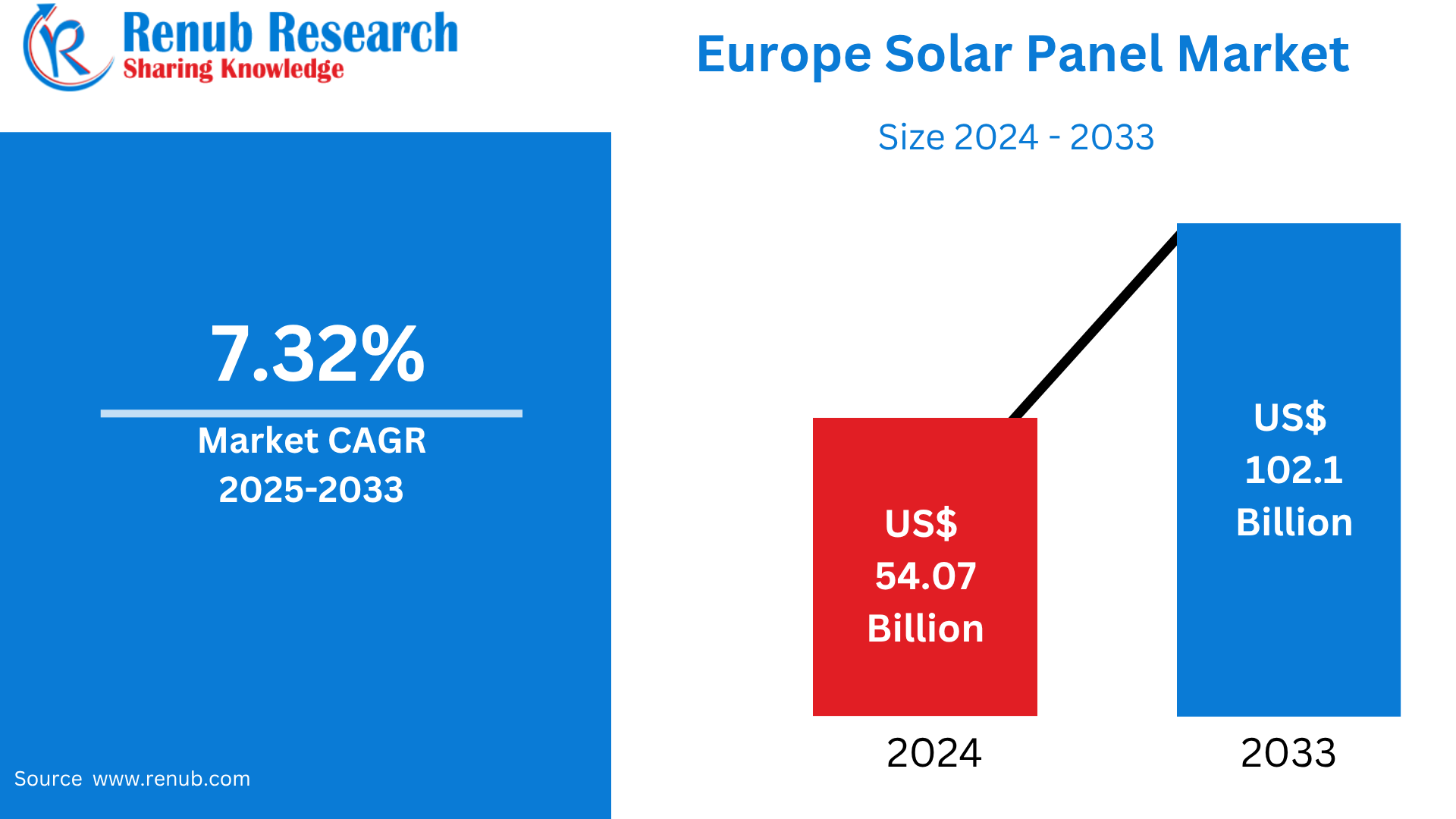
According To Renub Research Europe solar panel market is undergoing a transformative expansion as the region accelerates its transition toward clean, secure, and sustainable energy systems. Valued at around US$ 54.07 billion in 2024, the market is forecast to reach approximately US$ 102.1 billion by 2033, growing at a compound annual growth rate of 7.32% during 2025–2033. This growth trajectory reflects Europe’s deepening commitment to carbon neutrality, rising electricity demand, and the strategic need to reduce dependence on imported fossil fuels.
Solar energy has emerged as one of the most critical pillars of Europe’s renewable energy strategy. Strong policy backing from the European Union, falling solar technology costs, and rapid adoption across residential, commercial, and utility-scale projects are collectively shaping a resilient and diversified solar ecosystem. As energy independence and climate action converge as top priorities, the European solar panel market is expected to remain on a steady upward path throughout the forecast period.
Europe Solar Panel Market Overview
A solar panel, commonly referred to as a photovoltaic panel, converts sunlight into electricity using semiconductor materials, most often silicon. These panels are deployed across rooftops, ground-mounted solar farms, and integrated building systems to generate renewable electricity with minimal environmental impact. Solar panels reduce greenhouse gas emissions, limit reliance on fossil fuels, and support decentralized energy generation.
In Europe, solar power has evolved from a supplementary energy source into a core component of national and regional energy strategies. The European Union’s climate framework, combined with national renewable energy plans, has accelerated solar adoption across both mature and emerging markets. Countries such as Germany, France, Spain, Italy, and the Netherlands lead in installed capacity, while Central and Eastern Europe are witnessing rapid growth as solar becomes more affordable and accessible.
Declining installation costs, advancements in panel efficiency, and rising electricity prices have made solar power increasingly attractive to households, businesses, and utilities. Solar panels are now widely integrated into smart grids, energy storage systems, and digital energy management platforms. As Europe continues to modernize its power infrastructure, solar energy is expected to play a central role in achieving long-term sustainability and resilience.
Download Free Sample Report:https://www.renub.com/request-sample-page.php?gturl=europe-solar-panel-market-p.php
Drivers of Growth in the Europe Solar Panel Market
EU Green Energy Policies and Climate Objectives
Ambitious climate targets set by the European Union are a major driver of solar panel market growth. Under the European Green Deal, the EU aims to achieve climate neutrality by 2050, with interim goals to significantly reduce greenhouse gas emissions by 2030. Renewable energy expansion, particularly solar power, is a cornerstone of this strategy.
Supportive policies such as subsidies, feed-in tariffs, tax incentives, and renewable energy mandates encourage widespread adoption of solar panels. Member states are required to meet binding renewable energy targets under the Renewable Energy Directive, creating a stable and predictable investment environment. Large-scale funding mechanisms and recovery programs further stimulate solar deployment across residential, commercial, and utility-scale projects.
Fall in Cost of Solar Technology
The dramatic reduction in solar technology costs has made solar power one of the most competitive energy sources in Europe. Advances in manufacturing efficiency, economies of scale, and global supply chains have reduced the cost per watt of photovoltaic systems by more than 80% over the past decade.
Lower panel prices, combined with improved efficiency and longer lifespans, have shortened payback periods for solar investments. In countries with high electricity prices, solar installations offer immediate financial benefits. The integration of battery storage, smart inverters, and energy management systems further enhances the economic appeal of solar power, encouraging adoption across all end-user segments.
Energy Security and Reduced Import Dependence
Geopolitical uncertainties and supply disruptions have underscored the importance of energy security in Europe. Solar energy provides a locally generated, decentralized power source that reduces dependence on imported fossil fuels. Governments are promoting rooftop solar mandates, community solar initiatives, and simplified permitting processes to accelerate deployment.
This push for energy independence is particularly strong in regions historically reliant on energy imports. By diversifying energy sources and strengthening domestic generation capacity, solar power enhances resilience against external shocks while supporting long-term sustainability goals.
Obstacles to the Europe Solar Panel Market
Grid Integration and Infrastructure Constraints
One of the most significant challenges facing the European solar panel market is the integration of growing solar capacity into existing power grids. Many national grids were designed for centralized fossil fuel generation and are not fully equipped to manage variable, decentralized renewable energy sources.
Grid congestion, limited transmission capacity, and insufficient energy storage infrastructure can lead to inefficiencies and curtailment of solar power. Upgrading grids and deploying smart grid technologies require substantial investment and coordination among utilities, regulators, and policymakers. Without these upgrades, the scalability of solar energy may be constrained despite strong demand.
Regulatory and Bureaucratic Barriers
Although the EU promotes renewable energy, regulatory complexity at national and local levels can slow solar project development. Lengthy permitting processes, zoning restrictions, and inconsistent subsidy frameworks create uncertainty for investors and developers.
In some regions, reductions in feed-in tariffs or changes in incentive schemes have affected project viability. Residential and community solar projects may also face administrative hurdles that discourage participation. Streamlining regulations and harmonizing policies across member states will be essential to unlock the full potential of the European solar panel market.
Europe Crystalline Silicon Solar Panel Market
Crystalline silicon solar panels dominate the European market due to their proven performance, reliability, and high efficiency. This category includes monocrystalline and polycrystalline panels, which are widely used in residential rooftops, commercial buildings, and utility-scale solar farms.
Continuous improvements in crystalline silicon technology, such as bifacial modules and advanced cell architectures, have further enhanced efficiency and energy output. European consumers and developers favor these panels for their long operational life and strong return on investment, making them the backbone of solar adoption across the region.
Europe On-Grid Solar Panel Market
The on-grid solar panel segment is expanding rapidly as households and businesses connect their solar systems to national power grids. These systems allow excess electricity to be fed back into the grid, generating financial returns through net metering or export compensation schemes.
On-grid installations are particularly common in urban and suburban areas with reliable grid infrastructure. As utilities encourage distributed energy generation and smart grid integration, on-grid solar panels are expected to remain a dominant segment supporting Europe’s renewable energy objectives.
Europe Photovoltaic Solar Panel Market
Photovoltaic solar panels form the foundation of Europe’s solar energy landscape. PV technology is versatile and scalable, making it suitable for applications ranging from small residential systems to large solar parks.
Beyond traditional installations, PV panels are increasingly used in innovative applications such as building-integrated photovoltaics, where solar modules replace conventional building materials. Ongoing research into next-generation technologies, including advanced thin films and perovskite-based cells, holds promise for further efficiency gains and cost reductions.
Europe Monocrystalline Solar Panel Market
Monocrystalline solar panels are gaining market share in Europe due to their superior efficiency and sleek design. Their ability to perform well in low-light conditions makes them particularly suitable for northern European climates and space-constrained urban environments.
Although monocrystalline panels are typically more expensive than polycrystalline alternatives, their higher energy yield and aesthetic appeal justify the investment for many residential and premium commercial projects. Continued price declines are expected to further boost adoption.
Europe Residential Solar Panel Market
The residential solar panel market in Europe is experiencing strong growth driven by rising electricity prices, environmental awareness, and supportive incentive programs. Homeowners are increasingly installing rooftop solar systems to reduce energy bills and carbon footprints.
Advancements in smart home technology, battery storage, and digital monitoring tools have enhanced the appeal of residential solar installations. As self-consumption and energy independence become key priorities, residential solar adoption is expected to accelerate further.
Europe Lighting Solar Panel Market
Solar-powered lighting systems are gaining traction across Europe, particularly in public infrastructure, parks, parking areas, and rural locations. These systems offer a sustainable alternative to conventional lighting by reducing electricity consumption and operating costs.
Improvements in LED efficiency and solar panel performance have made solar lighting solutions more reliable and cost-effective. Municipal sustainability initiatives and green urban development programs continue to support gradual growth in this segment.
France Solar Panel Market
France is emerging as a significant contributor to Europe’s solar panel market, supported by ambitious national energy targets and policy incentives. The country promotes rooftop solar, utility-scale projects, and innovative concepts such as agrivoltaics to maximize land use efficiency.
Strong government backing, expanding manufacturing capacity, and rising investment in solar farms position France as a key growth market within Europe.
Germany Solar Panel Market
Germany remains the largest and most influential solar panel market in Europe. Long-standing policy support, public acceptance, and a well-developed grid infrastructure have enabled widespread adoption across residential, commercial, and community-based projects.
Germany’s energy transition strategy places solar power at the center of its long-term decarbonization goals, ensuring continued market leadership.
United Kingdom Solar Panel Market
The United Kingdom solar panel market is driven by high electricity prices, climate commitments, and increasing interest in energy self-sufficiency. Although traditional subsidy schemes have evolved, newer export and self-consumption models support ongoing adoption.
Large-scale solar farms and rooftop installations continue to expand, reinforcing the UK’s role as a key solar market in Europe.
Russia Solar Panel Market
Russia’s solar panel market is comparatively nascent but shows gradual progress as the country explores diversification of its energy mix. Solar installations are concentrated in regions with favorable sunlight conditions, supported by limited government incentives.
While challenges such as infrastructure limitations and fossil fuel dominance persist, long-term prospects for solar growth exist as global energy dynamics shift.
Market Segmentation
The Europe solar panel market is segmented by type, grid connection, technology, module type, application, end use, and country. Key categories include crystalline silicon and thin-film panels, on-grid and off-grid systems, photovoltaic and concentrated solar power technologies, and applications across residential, commercial, and industrial sectors. Country-level analysis highlights varying adoption patterns across Western, Central, and Eastern Europe.
Competitive Landscape and Key Players
The competitive landscape of the European solar panel market includes a mix of global manufacturers and regional players focused on innovation, scale, and supply chain efficiency. Key companies active in the market include Canadian Solar, Jinko Solar Holding Co. Ltd., JA SOLAR Technology Co. Ltd., Panasonic Corporation, Reliance, LG Electronics Inc., and First Solar.
These companies compete on technology innovation, efficiency, pricing, and sustainability credentials. Strategic partnerships, local manufacturing investments, and continuous R&D are expected to shape competitive dynamics through 2033.

 English
 Arabic
 French
 Spanish
 Portuguese
 Deutsch
 Turkish
 Italiano
 Russian
 Romaian
 Portuguese (Brazil)
 Greek
Greek