


Projection Welding: Precision and Efficiency for Modern Manufacturing
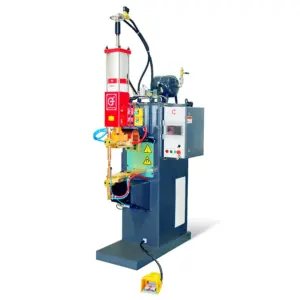
In today’s high-volume manufacturing, joining metal components with speed, accuracy, and reliability is crucial. Projection welding has emerged as a cornerstone process in industries such as automotive, electronics, aerospace, and appliance manufacturing, offering consistent weld quality, reduced operator dependency, and seamless integration with automated production lines.
At Heron Welder, we specialize in advanced resistance welding and metal-joining solutions, including projection welding machines, controllers, welding guns, and fully automated production lines, designed to optimize manufacturing efficiency while ensuring superior weld quality.
What is Projection Welding?
Projection welding is a type of resistance welding where raised sections, or “projections,” on one or both workpieces concentrate the welding current to precise locations. These projections act as localized points of resistance, generating heat under pressure to form a strong weld at the exact contact point.
Unlike traditional spot welding, where electrode placement directly determines the weld, projection welding allows for simultaneous welding of multiple points with a single electrode application. This reduces production time, ensures consistent welds, and minimizes surface damage to the workpiece.
How Projection Welding Works
The projection welding process involves the following steps:
-
Preparation: One or both metal sheets have embossed projections or indentations. These projections are typically designed to focus current and control heat generation.
-
Electrode Contact: Electrodes press the workpieces together at the welding points. The pressure ensures proper electrical contact while preventing excess deformation.
-
Current Flow: Electrical current flows through the projections, generating heat at the localized resistance points.
-
Metal Fusion: Heat melts the projection, forming a nugget that fuses the sheets together. The surrounding metal remains largely unaffected.
-
Cooling and Solidification: Pressure is maintained as the weld cools, creating a strong, consistent joint.
This method allows multiple welds to be formed simultaneously, improving cycle times for high-volume production.
Applications of Projection Welding
Projection welding is highly versatile and widely used in industries requiring precision, repeatability, and strength. Common applications include:
-
Automotive Manufacturing: Battery tabs, chassis components, brackets, and fastener welding.
-
Appliances: Electrical contacts, heating elements, and sheet metal assemblies.
-
Electronics: Small connectors, terminal welding, and precision enclosures.
-
Aerospace: Lightweight sheet metal assemblies requiring consistent, high-strength welds.
Its ability to weld thin and thick metals simultaneously, as well as multiple points in a single operation, makes projection welding ideal for automated production lines.
Projection Welding vs. Spot Welding
While both are resistance welding methods, projection welding and spot welding have distinct advantages:
| Feature | Spot Welding | Projection Welding |
|---|---|---|
| Number of Weld Points | Single per electrode | Multiple per electrode |
| Workpiece Preparation | Flat surfaces only | Projections required |
| Weld Consistency | Operator-dependent | High consistency via projections |
| Ideal Applications | Small assemblies, low-volume | High-volume, multi-point joints |
| Surface Impact | Can deform surrounding metal | Minimal deformation at non-weld areas |
In many automated manufacturing lines, projection welding reduces operator intervention, improves throughput, and ensures uniform weld quality critical for OEMs and industrial applications.
Best Practices for Effective Projection Welding
To maximize efficiency and weld quality, consider these best practices:
-
Projection Design: Ensure projections are correctly sized, shaped, and positioned for the required weld nugget.
-
Material Compatibility: Verify material thickness, conductivity, and hardness for optimal heat generation.
-
Electrode Maintenance: Keep electrodes clean, properly shaped, and free of oxidation to maintain consistent welds.
-
Machine Settings: Optimize current, pressure, and dwell time based on material type and thickness. Automated controllers can fine-tune parameters for repeatable results.
-
Quality Control: Employ monitoring systems or visual inspections to verify weld consistency and prevent defects.
Heron Welder’s projection welding machines and controllers provide precise parameter control, real-time monitoring, and integration options for automated production lines helping manufacturers achieve maximum efficiency and repeatable weld quality.
Why Choose Heron for Projection Welding Solutions
As a global leader in industrial welding and metal-joining solutions, Heron offers:
-
Customizable Machines: Spot, projection, seam, and MFDC welding solutions tailored to production requirements.
-
Automation Expertise: Fully integrated production lines combining welding, riveting, and clinching for efficient manufacturing workflows.
-
Advanced Controllers: Precision current, pressure, and timing control to ensure high-quality, repeatable welds.
-
After-Sales Support: Installation, training, maintenance, and technical support for OEMs and factory operations worldwide.
With decades of experience, Heron ensures manufacturers can rely on projection welding for consistent quality, higher throughput, and seamless automation.
FAQs About Projection Welding
1. Can projection welding handle different metal thicknesses?
Yes. By designing appropriate projections and adjusting current/pressure parameters, projection welding can join metals of varying thicknesses effectively.
2. Is projection welding suitable for automation?
Absolutely. Its ability to weld multiple points simultaneously makes projection welding ideal for high-volume, automated production lines.
3. How is projection welding different from resistance spot welding?
Projection welding uses raised points to focus current, allowing multiple simultaneous welds and minimal surface deformation, while spot welding joins single points directly.
4. Which industries commonly use projection welding?
Automotive, aerospace, electronics, appliances, and heavy machinery industries widely rely on projection welding for precision and repeatable joints.
5. How can I ensure consistent weld quality?
Proper projection design, precise machine settings, electrode maintenance, and quality monitoring are key. Heron’s machines and controllers simplify these processes.
Conclusion
Projection welding is a high-precision, high-efficiency solution for modern manufacturing, delivering strong, consistent welds while reducing operator dependence and enabling automation.
Whether for automotive assemblies, electronics, or industrial sheet metal fabrication, choosing the right equipment and expertise is crucial for optimal results.
Heron Welder offers advanced projection welding machines, automated solutions, and full technical support to help manufacturers maximize productivity and weld quality.
Ready to optimize your production line? Contact Heron today to request a quote or consult our team for custom projection welding and automated welding solutions tailored to your factory’s needs.

 English
 Arabic
 French
 Spanish
 Deutsch
 Turkish
 Dutch
Dutch
 Italiano
 Russian
 Romaian
 Portuguese (Brazil)
 Greek
Greek