


Industrial Surface Mounted Socket Placement And Safety Guidance By Nante
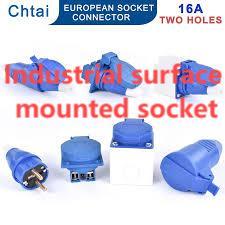
In many production spaces designers install a Industrial surface mounted socket near workstations to shorten cable lengths and reduce trip hazards, and floor managers expect that the chosen unit will resist impact, be serviceable, and offer simple labeling for quick troubleshooting. For mid-line power and temporary tool outlets, engineers often select a Industrial surface mounted socket that combines rugged materials with modular interiors so spare swaps don’t require enclosure replacement.
Placement and human-factor considerations
Good placement begins with observing how people actually work. Mount sockets where technicians naturally need power — next to benches, beside processing stations, or along maintenance routes — so cords don’t cross aisles or create fall risks. Consider ergonomic heights to avoid ladders and make visual inspection easier; recessed sockets or angled faceplates reduce accidental unplugging. Also plan for future flexibility: leave space for added outlets, monitoring modules, or cord-management clips so expansions won’t force a full rework.
Materials, protection ratings, and finishes
Selecting the right housing material is about matching exposure to longevity. UV-stabilized thermoplastics are economical for light-duty areas; powder-coated aluminum or stainless steel are better where impact and corrosive atmospheres are expected. Specify appropriate IP and IK ratings for the application — higher IP for washdown or outdoor exposure, higher IK where mechanical impact is likely. Gasket chemistry matters: EPDM, silicone, and nitrile each offer advantages against cleaners, temperature swings, and compression set. Choose fastener finishes and captive screws that resist theft and galvanic corrosion.
Installation best practices that preserve sealing
A correctly specified socket can still fail if installed poorly. Ensure mounting surfaces are flat and free of debris so gaskets seat evenly; uneven faces lead to leaks. Use manufacturer torque values for cover screws and cable glands — under-torquing invites ingress, over-torquing deforms seals. Create drip loops and position cable entries to avoid direct water channels toward seams. Where wall penetrations occur, add flashing or external collars to prevent tracking. Document torque values and cable-routing choices in as-built files so future crews reproduce the original intent.
Modular interiors and Nante accessory ecosystem
Opt for enclosures that accept removable mounting plates, DIN rails, and swappable inserts so a single faulty outlet or control module can be replaced without disturbing other circuits. Nante-compatible accessory kits — prewired terminal assemblies, surge modules, and spare plates — shorten repair times and reduce spare-part variety across multiple sites. Standardized interior footprints across product families allow technicians to carry a compact spare kit and complete most repairs on a single visit, drastically cutting mean time to repair.
Thermal control, condensation, and lifecycle planning
Even sealed surface-mounted sockets can trap heat or collect moisture. Separate heat-generating devices from sensitive electronics and consider thermally conductive mounting plates when heavy loads are present. For condensation-prone areas, use breathable filters, desiccant packs, or low-wattage thermostatic heaters that preserve ingress protection while managing moisture. Implement a simple inspection checklist — gasket condition, gland torques, corrosion, and terminal torque readings — and log replacements to build realistic lifecycle forecasts. Treat common gaskets and small inserts as consumables and set reorder points to avoid emergency procurement.
Security, public-space installations, and aesthetics
Public or semi-public installations often require tamper resistance without sacrificing accessibility. Lockable lids, tamper-proof fasteners, and recessed anchors deter interference while allowing authorized maintenance. For visual-sensitive environments, choose low-gloss finishes and color matches that blend with the surroundings. Consider discreet status indicators that allow authorized staff to verify system health without opening the enclosure.
Procurement language and specification tips
Write prescriptive purchase documents: list required IP/IK ratings, gasket material, fastener finish, internal mounting options, and compatible accessory part numbers. Require vendors to supply type-test evidence and compatibility matrices. Ask for wiring diagrams and splice lists with deliveries to reduce on-site surprises. Clear procurement language reduces variation between suppliers and makes installations more predictable and auditable.
A thoughtfully chosen and properly installed surface-mounted power solution reduces downtime, simplifies maintenance, and lowers total cost of ownership. Prioritize placement, material selection, installation discipline, and a compact spare strategy to keep floor operations safe and productive. For product data, accessory compatibility, and installation guides from Nante, visit www.nante.com

 English
 Arabic
 French
 Spanish
 Portuguese
 Deutsch
 Turkish
 Dutch
Dutch
 Italiano
 Romaian
 Portuguese (Brazil)
 Greek
Greek